Category: MacRumors

Category Added in a WPeMatico Campaign

Apple Temporarily Relaxes Notarization Requirements in macOS Catalina for Non Mac App Store Apps

Apple this afternoon reminded developers about upcoming notarization requirements for Mac apps created outside of the Mac App Store.

Apps that are distributed outside of the Mac App Store must be notarized by Apple in order to run on the macOS Catalina operating system set to be released this fall.

Apple says that to make the transition easier on both developers and Mac users, notarization prerequisites have been adjusted until January 2020.

Developers can now have apps notarized that do not meet certain previous requirements, such as an app that uses an older SDK or the inclusion of components not signed by a developer ID.

Apple has a full list of allowances on its developer website:

You can now notarize Mac software that:

– Doesn’t have the Hardened Runtime capability enabled.

– Has components not signed with your Developer ID.

– Doesn’t include a secure timestamp with your code-signing signature.

– Was built with an older SDK.

– Includes the com.apple.security.get-task-allow entitlement with the value set to any variation of true.

Apple has been requiring new software distributed with a Developer ID outside of the Mac App Store to be notarized in order to run since macOS Mojave 10.14.5.

Apple introduced notarization in macOS Mojave as a way to further protect Mac users from malicious and harmful apps.

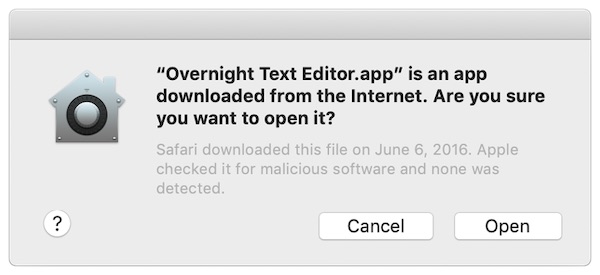
For the notarization process, Apple provides trusted non Mac App Store developers with Developer IDs that are required to allow the Gatekeeper function on macOS to install non Mac App Store apps.

Notarization is not required for apps that are distributed through the Mac App Store. More information on notarization can be found on Apple’s developer site.

This article, “Apple Temporarily Relaxes Notarization Requirements in macOS Catalina for Non Mac App Store Apps” first appeared on MacRumors.com

Discuss this article in our forums

Powered by WPeMatico

Apple Nixes ‘Bastards’ TV Show Starring Richard Gere

Apple is not moving forward with “Bastards,” a show based on an Israeli mini-series that was set to star Richard Gere, reports Variety.

Apple acquired the rights to the series, described as a violent and mature drama, last year. Apple outbid Showtime, FX, and Amazon for the show, and gave it a straight to series order.

Image Credit: Rex Features


The Israeli version of the show (called “Nevelot,” which is “Bastards” in Hebrew) focused on two military veterans who go on a killing spree targeting young people who “don’t understand the sacrifices of their generation.”

Richard Gere was going to star in the series and he had also signed on to executive produce. The plan was to reformat the show for an American audience, turning the two veterans into Vietnam vets among other changes, but the premise may have been too violent for Apple. It was set to feature two elderly Vietnam vets who find their lives upended when a woman they loved fifty years ago is killed by a car, leading them on a spree of violence.

According to Variety, development on the show was ended due to creative differences between Apple and the producers. Apple released the project and ended up paying a “large financial penalty.” This is the second show Apple has shelved that we know of. Apple also halted development on “Vital Signs,” a TV series based on the life of Dr. Dre, reportedly due to scenes of gun violence and drug use.

There have been mixed rumors suggesting Apple is avoiding content that is “edgy” and adult-oriented in nature for Apple TV+, but there are a wide variety of shows in the works, some of which do appear to have adult content. Apple iTunes chief Eddy Cue recently said that Apple execs are not involved in the development of Apple TV+ shows and do not have editorial input.

“I saw the comments that myself and Tim were writing notes on the scripts and whatever,” said Cue. “There’s never been one note passed from us on scripts, that I can assure you. We leave the folks [alone] who know they’re doing.”

Apple has dozens of TV shows and movies in development for Apple TV+, and the service is set to launch this fall. Initial offerings will include “For All Mankind,” “Dickinson,” and “The Morning Show.”

Note: Due to the political nature of the discussion regarding this topic, the discussion thread is located in our Politics, Religion, Social Issues forum. All forum members and site visitors are welcome to read and follow the thread, but posting is limited to forum members with at least 100 posts.

This article, “Apple Nixes ‘Bastards’ TV Show Starring Richard Gere” first appeared on MacRumors.com

Discuss this article in our forums

Powered by WPeMatico

iOS App ‘UVLens’ Apparently Hacked, Sends Out Very Inappropriate Notifications [Updated]

An iOS App Store weather app called “UVLens” this morning sent out highly inappropriate pornographic notifications to all of its users, suggesting the app may have been hacked or otherwise compromised in some way.

There are dozens of complaints from users on Twitter who received the notification, which was in no way weather related and was explicit enough to shock users who received it.

UVLens is a simple app designed to provide hourly UV forecasts for those who are concerned about their sun exposure. It is a general use app and it’s quite possible that it could have been downloaded by children given its 4+ age rating.

UVLens appears to have sent out the notification to all of its users given the volume of tweets, and one person said that when she tapped the incoming notification, it tried to open a secondary window.

MacRumors was alerted to the issue by editor Mitchel Broussard, who has been using the app for more than a year. Prior to today, the app worked well and sent out no inappropriate content to users. We’ve never before seen reports of an app sending out notifications like this, so it’s rather unusual.

Apple does not appear to have a solid reporting system in place for instances like this, as we discovered after the notifications went out. UVLens has not yet commented on the situation.

There’s a “Report a Problem” website for reporting issues with recently purchased iOS apps, but it does not work with older purchased apps that suddenly go rogue. There’s no report button in the App Store for individual apps, no option when 3D Touching an app on the Home screen, and no clear support path for alerting Apple about problematic apps.

We have contacted the UVLens developer, and multiple people have been sending complaints on Twitter, so the app may be removed from the App Store or fixed in the near future.

For now, customers who have installed UVLens will likely want to delete the app because it’s not clear what’s going on and if there has been a breach of some sort.

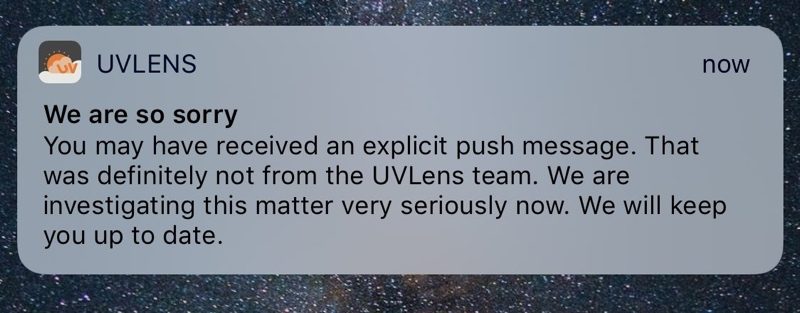
Update: UVLens sent out another notification, apologizing for the explicit push notification. The company says that it was not from the UVLens team and is being investigated.


Update 2: UVLens tells MacRumors that a third-party push notification service that it uses was compromised, allowing a spammer to send out inappropriate notifications through the network, including to UVLens users. UVLens says that steps were taken to prevent it from happening again and no app software was compromised.

This article, “iOS App ‘UVLens’ Apparently Hacked, Sends Out Very Inappropriate Notifications [Updated]” first appeared on MacRumors.com

Discuss this article in our forums

Powered by WPeMatico
Apple Watch Bands With Self-Tightening, Skin Texture Authentication, and LED Progress Bar Detailed in Patents

The U.S. Patent and Trademark Office today granted Apple several patents for smart Apple Watch bands with features such as biometric authentication, self-tightening, and an LED progress indicator, as noted by Patently Apple.

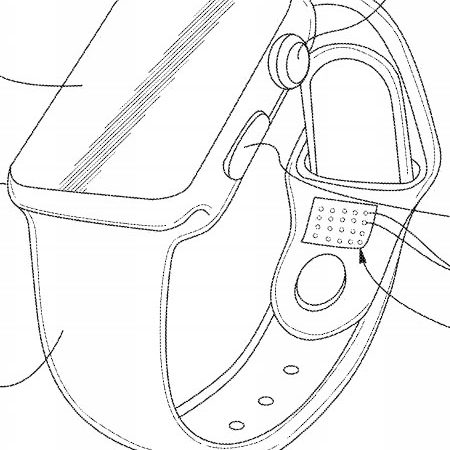
Apple Watch with biometric sensor


The first patent describes an Apple Watch band with a sensor that can authenticate the wearer based on patterns in their wrist’s skin texture:

More particularly, skin texture cracks are generally warmer than the surrounding skin, and hair is cooler than the surrounding skin. By using an IR thermal image sensor as the wrist biometric sensor, hair can be distinguished, thermally, from skin texture cracks by temperature.

This feature would eliminate the need to enter a passcode on the Apple Watch or a paired iPhone to unlock the watch.

The second patent describes a self-tightening Apple Watch band. If the wearer is running or working out, for example, the band could automatically tighten in order to ensure it has a snug fit on the wrist while exercising. Upon completion of the physical activity, the band would then automatically loosen.

Apple Watch users would be able to set locations where the band automatically tightens upon arrival, such as a gym.

In other examples, the band could automatically tighten to notify a user of an upcoming turn while walking, driving, or swimming; to help the wearer count repetitions while weight lifting; or to notify the wearer that they have reached certain distance intervals while running, such as every mile.

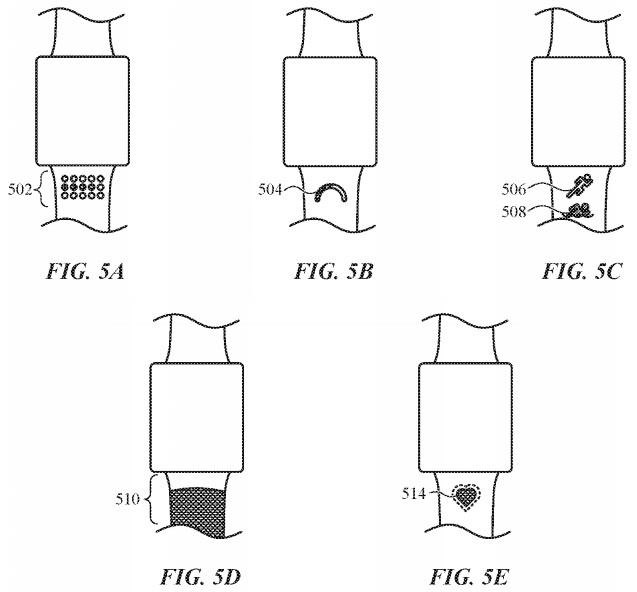
A self-tightening Apple Watch band


The self-tightening band could also be part of a two-factor authentication system on the Apple Watch, as described in the patent:

For example, if a user wishes to access financial details hosted on a banking website, the banking website may require both the user’s credentials and a verification of a number of tightening-loosening patterns sent to a wearable electronic device previously authenticated by the banking website…

In one example, a tactile pattern may be a series of five squeezes of the user’s wrist (e.g., tighten and loosen in sequence). The user may thereafter enter “5” to gain access to the banking website.

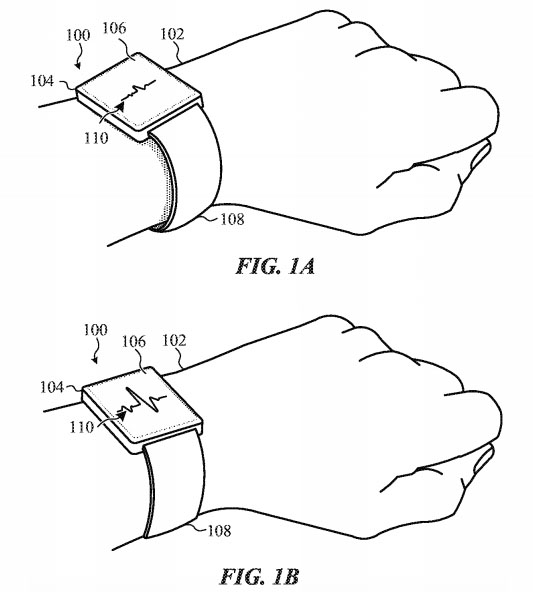
The third patent describes an Apple Watch band with an LED indicator that would visualize the progress of an activity or task, such as completion of Walk, Stand, and Exercise rings. The indicator could also serve as an easy way to check an Apple Watch‘s remaining battery life at a glance.

Apple Watch bands with various LED indicators


Apple is hosting a special event at Steve Jobs Theater next Tuesday, where it is widely expected to unveil new iPhone and Apple Watch models. While a seasonal band refresh is expected, there have been no rumors or leaks about smart bands.

Keep in mind that Apple is granted dozens of patents every week, and many of the inventions do not see the light of day. Patents are also very detailed, encompassing many possible ideas, even ones that Apple might not have any plans to advance. So, whether any of these bands come to fruition remains to be seen.

Related Roundups: Apple Watch, watchOS 5, watchOS 6
Tag: patent
Buyer’s Guide: Apple Watch (Caution)

This article, “Apple Watch Bands With Self-Tightening, Skin Texture Authentication, and LED Progress Bar Detailed in Patents” first appeared on MacRumors.com

Discuss this article in our forums

Powered by WPeMatico
USB4 Specification Merges Thunderbolt 3 and USB With Transfer Speeds up to 40Gb/s

The USB4 specification for a new version of USB was today published by the USB Implementers Forum [PDF] giving us details on what to expect from the next-generation USB architecture following a preview back in March.

USB4 is a major update that “complements and builds upon” the current USB 3.2 2×2 (USB-C) and USB 2.0 architectures. According to the USB-IF, the USB4 architecture is based on Thunderbolt, doubling the maximum bandwidth of USB and allowing for multiple simultaneous data and display protocols.

The USB-IF outlined key specifications of the USB4 architecture, such as 40Gb/s speeds (twice the current 20Gb/s maximum) and backwards compatibility with USB 3.2 and Thunderbolt 3.

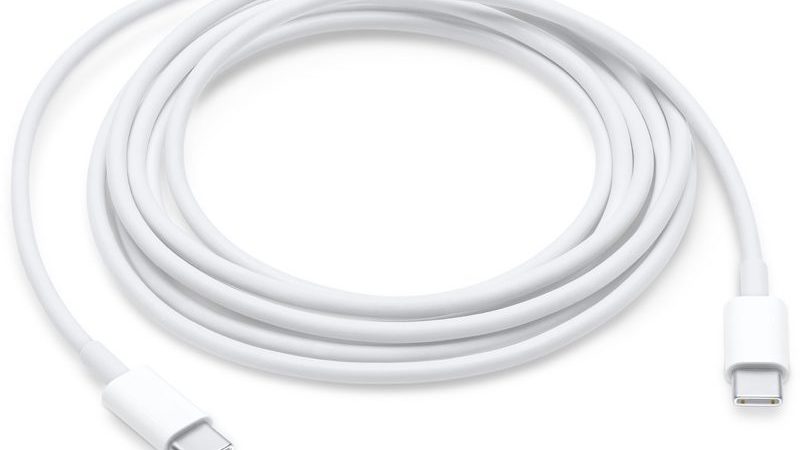
  • Two-lane operation using existing USB Type-C cables and up to 40Gbps operation over 40Gbps certified cables
  • Multiple data and display protocols that efficiently share the maximum aggregate bandwidth
  • Backward compatibility with USB 3.2, USB 2.0 and Thunderbolt 3

USB4 will use the same USB-C connector design as USB 3, which means manufacturers will not need to introduce new USB4 ports into their devices.

Apple’s newest Macs offer support for USB-C and Thunderbolt 3, which means most Mac users are already experiencing USB4 speeds when using Thunderbolt 3 cables and devices, but USB4 will make Thunderbolt-style speeds the new default and it will lower the cost of devices that use these faster transfer speeds.

USB Power Delivery will be required in devices built for USB4, which also means we can expect to see higher-powered chargers with multiple USB4 ports.

Though the USB4 specification is complete, it will still be some time before we can expect to see devices that take advantage of USB4. It typically takes at least a year for new products to come out following the finalization of a new specification, so it will be late 2020 or beyond before we begin seeing USB4 devices.

This article, “USB4 Specification Merges Thunderbolt 3 and USB With Transfer Speeds up to 40Gb/s” first appeared on MacRumors.com

Discuss this article in our forums

Powered by WPeMatico
New Yorkers Losing So Many AirPods in Subway Tracks That MTA is Considering a PSA to Warn Commuters

So many AirPods have been lost in New York City subway tracks in recent months that the MTA is considering initiating a public service announcement urging commuters to refrain from taking AirPods on or off while entering or exiting trains, a spokesperson for the transit agency told The Wall Street Journal.

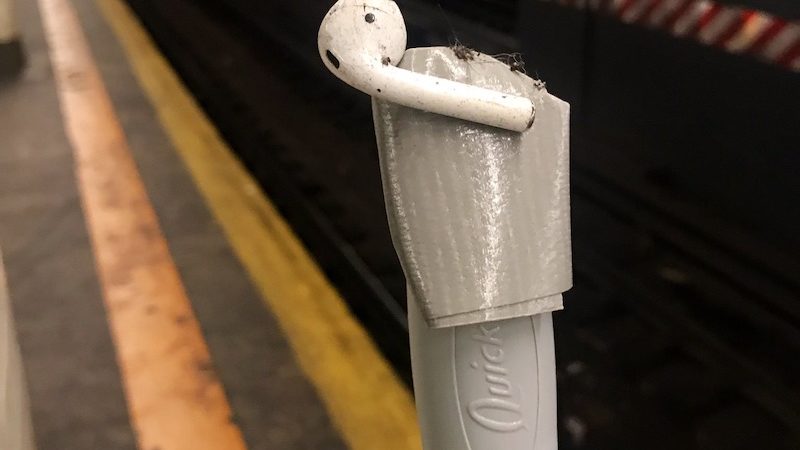
Ashley Mayer recovered her AirPods with a broom and duct tape


The PSA would hopefully alleviate the delays caused by the numerous AirPods that fall between the cracks each day:

“They’re tiny. They’re hard to find,” said Steven Dluginski, an MTA maintenance supervisor. Given the darkened tracks where they drop, he said, “the only saving grace is that they’re white.”

AirPod rescues from New York City subway tracks ramped up in March, when Apple released a new version, Mr. Dluginski said. This summer has been the worst, possibly because the heat and humidity on subway platforms makes the ears and hands of New Yorkers pretty sweaty, he guessed.

Transit workers use a pole that extends to about 8 feet and has two rubber cups on the end that can be squeezed together to grab small objects. The “picker-upper thing,” Mr. Dluginski called it.

Around noon on a recent Thursday, Mr. Dluginski’s team had received 18 requests to fetch lost items. Six were for AirPods. “It’s job security, as far as we’re concerned,” the maintenance boss said.

While the location of AirPods can be tracked using the Find My iPhone app, the earphones often become trapped in hard-to-reach places due to their small size. This led The Wall Street Journal to highlight the extravagant measures that some customers have taken to recover their lost AirPods:

Passenger Ashley Mayer recently live-tweeted a track rescue in a lull between passing trains. One photo, featuring the caption “game on,” showed her purchasing a broom and duct tape. She used the contraption to nab the AirPod from the tracks, which can be dotted with rats.

In an extreme case, well-known Apple analyst Gene Munster admitted that he has apparently lost 10 pairs of AirPods.

Apple charges $69 for a replacement AirPod in the United States, totaling $138 for a pair. Replacement charging cases are also available for $59, while the wireless AirPods charging case is sold separately for $79.

Paywalled article: America’s Stormy Affair with Apple AirPods: Love ‘Em and Lose ‘Em

Related Roundup: AirPods 2
Buyer’s Guide: AirPods (Buy Now)

This article, “New Yorkers Losing So Many AirPods in Subway Tracks That MTA is Considering a PSA to Warn Commuters” first appeared on MacRumors.com

Discuss this article in our forums

Powered by WPeMatico
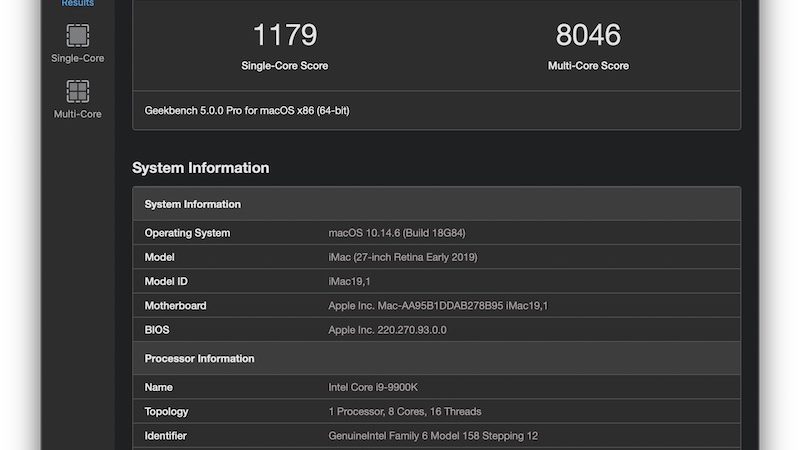
Geekbench 5 Released With Improved Benchmark Tests, Dark Mode Support, and More

Primate Labs today announced the release of Geekbench 5, the latest major version of its popular benchmark software.

For CPUs, Geekbench 5 features new benchmark tests and it also increases the memory footprint of existing workloads to more accurately account for the effect memory performance has on CPU performance:

The Geekbench 5 CPU Benchmark includes new benchmark tests that model the challenges your system faces when running the latest applications. These tests use cutting-edge technologies, including machine learning, augmented reality, and computational photography.

Geekbench 5 also increases the memory footprint of existing workloads to more accurately account for the effect memory performance has on CPU performance.

Finally, the Geekbench 5 CPU Benchmark includes new modes of multi-threaded benchmarks, allowing threads to work co-operatively on one problem rather than separately on different problems. With the addition of different threading models, Geekbench 5 better captures the performance of different multi-threaded applications on personal computing devices.

As for GPUs, the Compute benchmark now supports Vulkan in addition to Metal, CUDA, and OpenCL.

Geekbench 5 also has a refreshed user interface with full support for Dark Mode on macOS Mojave and later. Support for Dark Mode on iOS 13 will be available later this year, according to Primate Labs.

Geekbench 5 is available now for macOS, iOS, Windows, and Linux, with an Android version coming later this week. The software is 64-bit only, dropping support for 32-bit processors and operating systems.

Through September 10, Geekbench 5 and Geekbench 5 Pro for Mac are on sale for $7.49 and $49.99 respectively, down from $14.99 and $99.99. Geekbench 5 for iOS is also free until that time, while Geekbench 5 Pro for iOS has introductory pricing of $4.99, which will rise to $9.99 after the sale ends.

This article, “Geekbench 5 Released With Improved Benchmark Tests, Dark Mode Support, and More” first appeared on MacRumors.com

Discuss this article in our forums

Powered by WPeMatico
Apple Card Found to Contain 90% Titanium and 10% Aluminum

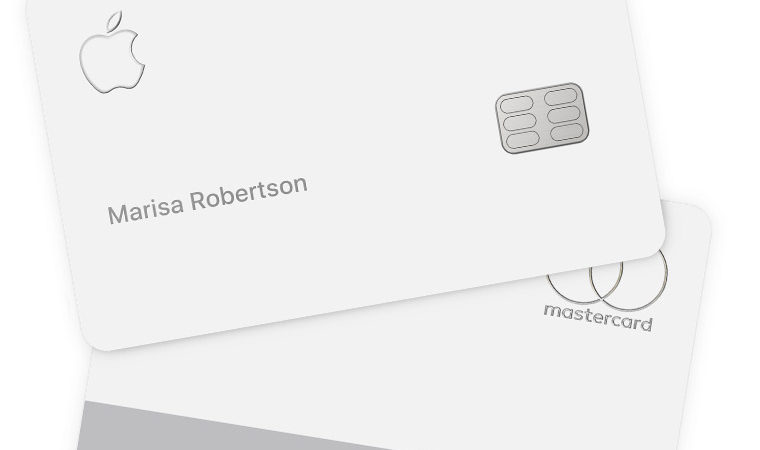
Bloomberg Businessweek sent an Apple Card to University of California, Berkeley professor and mineralogist Hans-Rudolf Wenk to determine the card’s atomic makeup. The answer: 90% titanium and 10% aluminum.

From the report:

But how much titanium? To find out, a Bloomberg Businessweek reporter sent his card to a mineralogist, University of California, Berkeley professor Hans-Rudolf Wenk. Professor Wenk used what’s known as a scanning electron microscope, or SEM device, to determine the card’s atomic makeup. He found that the answer is about 90%. The rest of the card is aluminum, according to the analysis.

Apple previously said the card’s white finish is achieved through a “multi-layer coating process” that is added to the titanium base material. In a recent support document, Apple said if the card comes into contact with hard surfaces or materials, it is possible that the coating can be damaged.

Apple also said some fabrics, like leather and denim, might cause permanent discoloration on the card that will not wash off.

This article, “Apple Card Found to Contain 90% Titanium and 10% Aluminum” first appeared on MacRumors.com

Discuss this article in our forums

Powered by WPeMatico
Samsung Plans to Launch a Flip Phone-Style Device With 6.7-inch Bendable Display Early Next Year

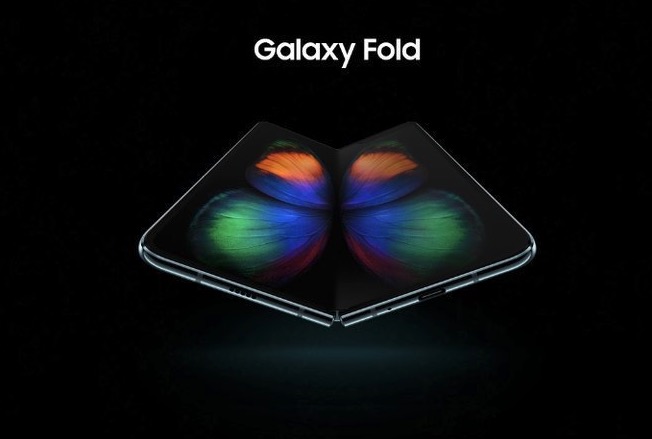
Undeterred by its recent Galaxy Fold un-launch, Samsung is apparently set to unveil a luxury smartphone early next year that can be folded down into a compact-sized square, according to a new report from Bloomberg.

Samsung’s Galaxy Fold hasn’t even been released yet

The South Korean smartphone giant is working on a device with a 6.7-inch inner display that shrinks to a pocketable square when it’s folded inward like a clamshell, according to people familiar with the product’s development.

The smartphone giant is said to be collaborating with American designer Thom Browne on the upcoming phone, with the aim of “appealing to a broader range of consumers that includes those more interested in fashion, status and luxury than a device’s tech specs.” At the same time, the device will reportedly feature cutting-edge display technology and offer the nostalgic appeal of rejuvenating the flip-phone form factor.

The foldable phone is said to include a hole-punch selfie camera at the top of the inner display, while on the outside it will have two cameras that face rearwards when the phone is open and become front-facing when the device is flipped closed.

According to the paper’s sources, Samsung aims to make its second bendable smartphone more affordable and thinner than this year’s Galaxy Fold, although the launch of the successor device “may… hinge on how well the Fold performs after its imminent launch.”

On that note, Samsung is said to have completed its redesign of the Galaxy Fold to resolve the multiple display failures that led to its delay. The South Korean company originally planned to roll out its $1,980 foldable phone on April 26, but was forced to delay the launch after several units sent out to reviewers broke during testing.

All of the issues were related to the device’s screen, which was vulnerable to debris ingress. The new version of the Galaxy Fold, featuring several design and construction improvements, is now set to launch in September in select markets, with specific launch details to be shared as a launch approaches.

There have been some suggestions that Apple is exploring folding screen technology, but right now there are no rumors indicating Apple plans to actually release a foldable smartphone in the near future.

This article, “Samsung Plans to Launch a Flip Phone-Style Device With 6.7-inch Bendable Display Early Next Year” first appeared on MacRumors.com

Discuss this article in our forums

Powered by WPeMatico
Apple Pay Expands to More Banks in Netherlands and Launches in Country of Georgia

Apple Pay officially launched in the Netherlands in June, but Dutch bank ING was the sole card issuer offering support Apple’s digital payment system to the country.

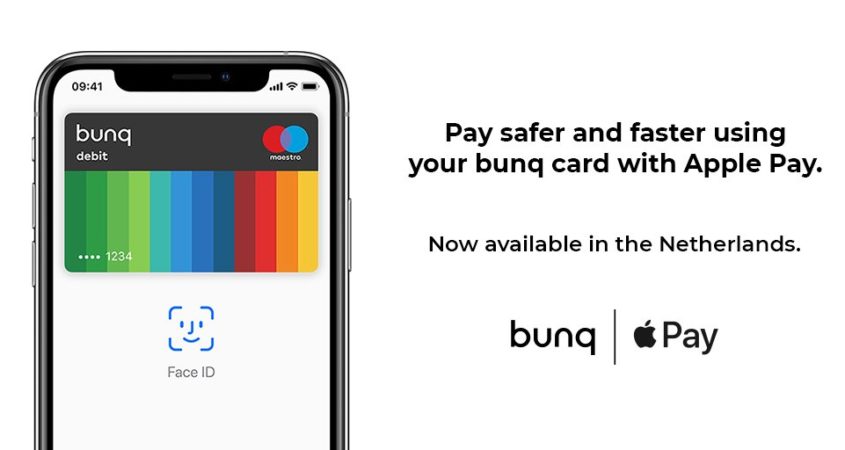
Today, more banks in the Netherlands announced support for Apple Pay. Dutch challenger bank Bunq now shows up in Apple’s Wallet when users in the country choose to add a card, as does Monese, N26, and Revolut.

With Apple Pay on iPhone, Apple Watch, iPad and Mac, customers with these banks in The Netherlands can make purchases with their digital wallet in stores, in apps and on websites.


According to Apple’s regional Apple Pay web page, Apple Pay can be used in The Netherlands with several online and high street retailers including Adidas, ALDI, Amac, ARKET, BCC, Burger King, Capi, cool blue, COS, Decathlon, Douglas, H&M, Jumbo, Lidl, McDonalds, Starbucks, and others.

Dutch banks ABN AMRO and Rabobank have also announced that they are working to bring Apple Pay support to their customers and both expect this to roll out soon.

(Thanks, Adriaan!)

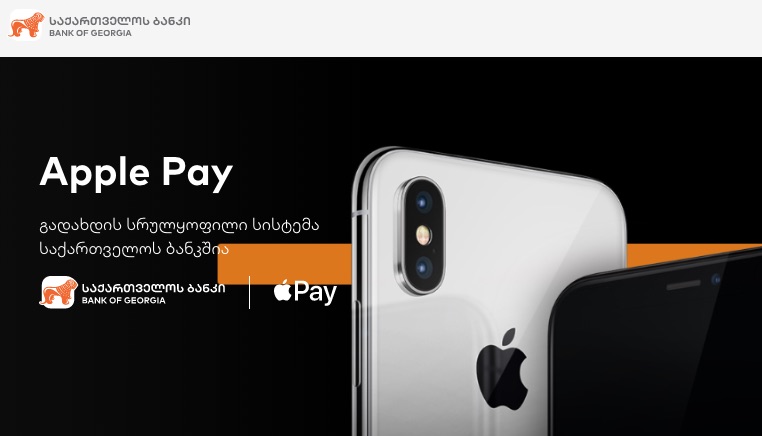
Update: Apple Pay has also launched in the country of Georgia for Bank of Georgia credit card holders.


(Thanks, David!)

This article, “Apple Pay Expands to More Banks in Netherlands and Launches in Country of Georgia” first appeared on MacRumors.com

Discuss this article in our forums

Powered by WPeMatico